Before You Design a Fix, Find the Real Failure
There is a question I ask in every diagnostic that makes clients uncomfortable. Not because it is difficult, but because it is simple, and because the honest answer almost always implicates someone in the room. It does not matter whether the system is a solid waste collection, a public hospital, a water utility, a housing programme, or an urban transport network. The question is the same.
The question is: Why? Not once. Three times. And the discipline, the part most practitioners skip, is in not accepting the first answer.
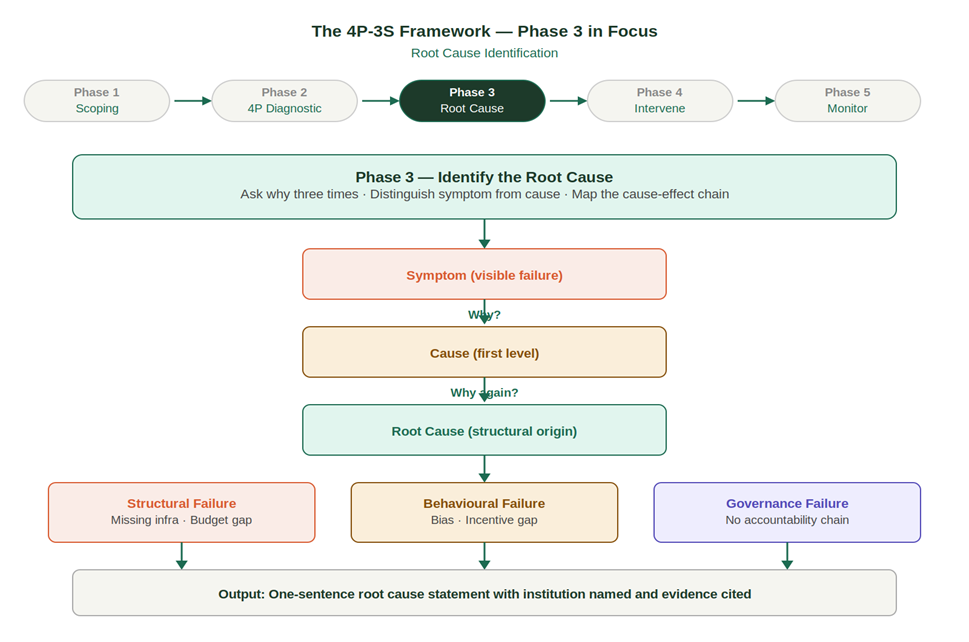
The root cause is almost always one layer deeper than the most obvious explanation. The discipline is in not stopping early.
The three ‘WHY’ chain: how it works in practice
Symptom: A service is not reaching the people it is meant to serve. A target is being missed. A complaint is recurring. A system is visibly not working.
Why? The frontline actor, the worker, the officer, the service provider, is not performing as the system expects.
Why again? There is no monitoring system that tracks whether the task is completed. Or there is one that tracks it, but triggers no consequence when it is not.
Root cause: The accountability structure governing the service has no enforceable performance obligation tied to outcomes. The operator, contractor, or institution is measured on activity, reports filed, budget spent, infrastructure built, not on whether the service actually reached the person it was designed to serve.
Stop at the first why and you add more resources or staff. Problem persists. Stop at the second and you build a better monitoring dashboard. Problem persists. Get to the third and you understand that the incentive structure itself rewards the wrong behaviour. That requires a governance intervention, a change in what is measured and what is consequential, not an operational one.
Three failure types: only one is the root cause
Every sustainability system failure traces to one of three root cause categories. Identifying which one determines the entire intervention design.
Structural failure: Something critical is missing from the system. Infrastructure planned but never built. A role that exists on paper but has no person filling it. A budget allocated but consistently underspent on the wrong line. This appears across every sustainability domain: in solid waste, healthcare, water, housing, and mobility. The fix requires capital, capacity, or both. Not a campaign. Not a policy circular. Not another awareness drive.
Behavioural failure: The infrastructure exists. The rules exist. But one or more actors are not behaving as the system requires, not out of malice, but because the design creates ambiguity, the incentive points the wrong way, or the default behaviour leads somewhere the system never intended. This shows up as patient non-compliance, worker non-adherence, and communities bypassing formal systems to access informal ones. The fix is not more communication. It removes ambiguity, realigns incentives, or changes what the default behaviour produces.
Governance failure: The most common root cause in chronic sustainability failures, and the hardest to name in a room. The rules exist. The infrastructure exists. The budget exists. No one is accountable for making the system work. Performance reviews are not held. Penalty clauses are not invoked. Escalation paths exist in documents and are never used. The institution responsible for oversight has no consequences for failing to oversee. This requires a structural governance fix, named accountability, enforceable obligations, and a feedback loop that cannot be quietly bypassed.
Why practitioners consistently get this wrong
There are two reasons why root cause identification is underperformed in sustainability practice.
The first is time pressure. Clients want solutions. Funders want deliverables. The pressure to move to intervention design before the diagnostic is complete is constant and real. Resisting it is a professional discipline, not a personality preference. I build a fixed, non-compressible diagnostic period into every engagement specifically to protect this step.
The second is political discomfort. A root cause that is a governance failure implicates the governing institution. A root cause that is a structural failure implicates whoever controlled the capital budget. The honest diagnosis threatens someone. The vague diagnosis threatens no one and changes nothing. Being specific about root causes, with evidence, in the presence of the people responsible for them, is the core professional skill of this work.
The most dangerous thing a practitioner can do is identify a symptom as a root cause and design an intervention around it. You will produce a well-funded fix that changes nothing structural. And the system will revert.
Phase 3 roadmap: three steps before moving to intervention
1. Run the three-why chain in writing for every finding. Document it. Make it visible in your reporting. Not as a narrative, but as a structured chain with a named institution or actor at the end.
2. Classify the root cause. Structural, behavioural, or governance. The classification determines the intervention type. Get this wrong, and even the most technically impressive intervention will not hold.
3. Name the actor or institution the root cause implicates. Not "the system lacks accountability." But: "Institution X has not convened a performance review meeting in four months despite a contractual obligation to do so monthly, indicating a governance failure in the oversight architecture." That specificity is what makes a root cause actionable. Vague diagnoses produce vague interventions. Precise diagnoses produce precise, measurable fixes.