Why Single-Dimension Fixes Never Last
Most urban systems have not one failure but four, happening simultaneously, compounding each other. Phase 2 of the 4P-3S Framework maps each dimension independently, then looks for connections. Because if you start by looking for connections, you end up finding the most visible one and stop.
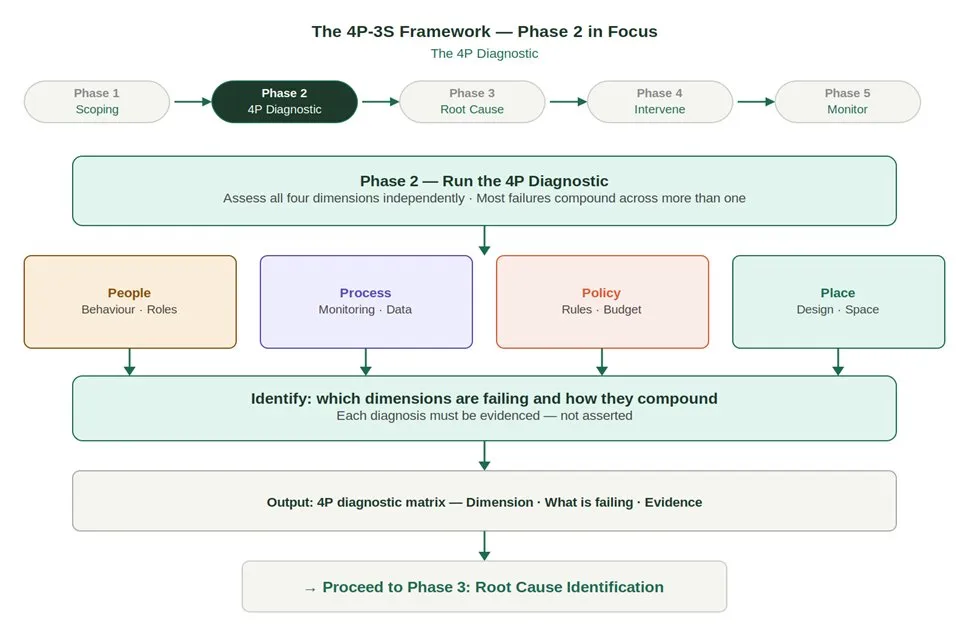
The Phase in Practice
A city launches a waste segregation awareness campaign. Residents attend. Posters go up. Three months later, the compliance rate remains the same. A hospital redesigns its waiting area, new seating, and better signage. Six months later, the same overcrowding. A water utility installs a grievance app. The app is quietly uninstalled.
Each is a well-intentioned single-dimension intervention. Each addresses one aspect of a problem that lives across four.
Sustainable urban service delivery requires all four dimensions to function simultaneously. Fix one, the other three pull it back.
The four dimensions: Diagnosed Independently (4P Matrix)
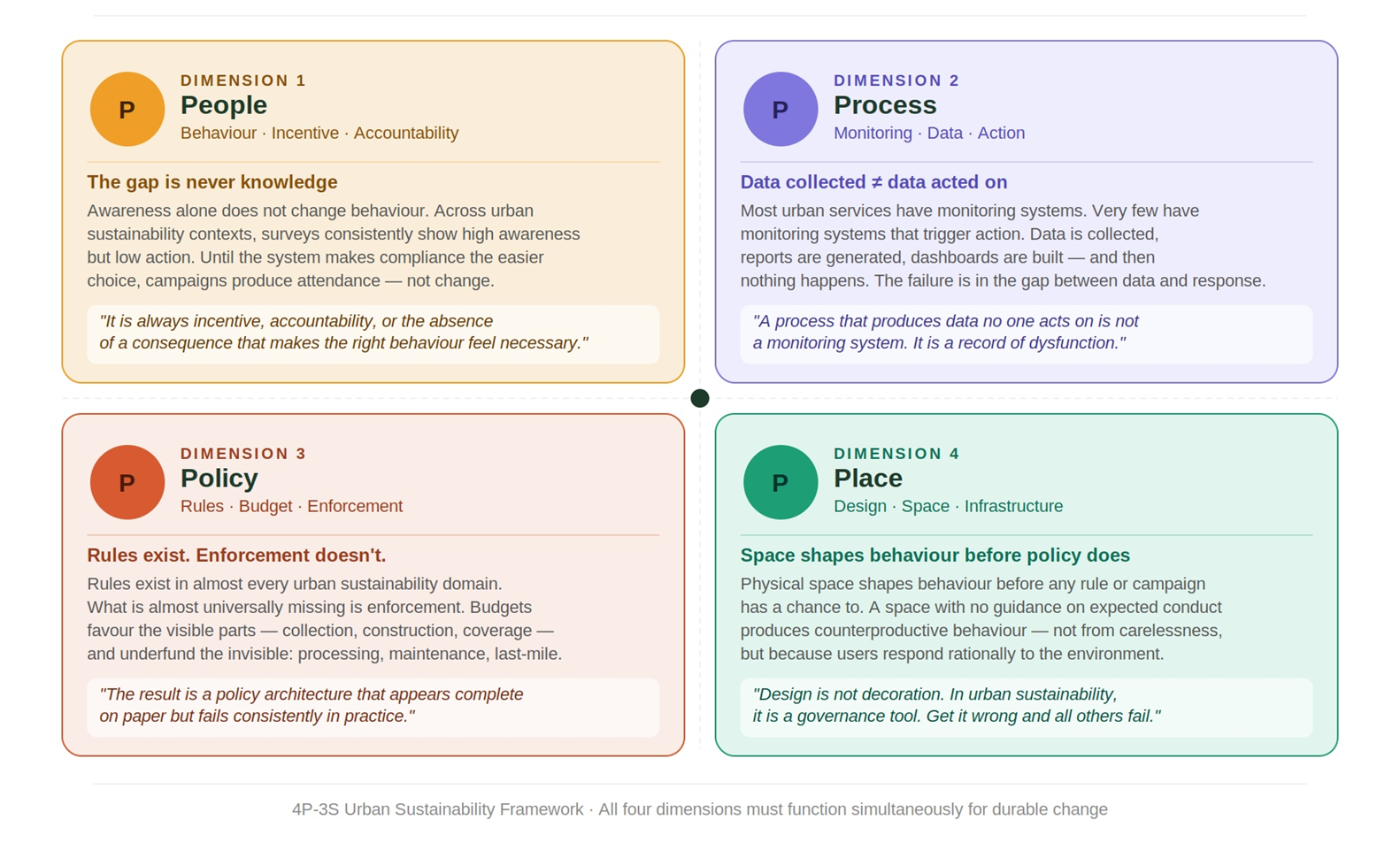
People: Awareness alone does not change behavior. Across urban sustainability contexts, from waste segregation to water conservation to healthcare compliance, surveys consistently show high awareness but low action. The gap is never knowledge. It is always incentive, accountability, or the absence of a consequence that makes the right behavior feel necessary. Until the system makes compliance the easier choice, awareness campaigns produce attendance, not change.
Process: Most urban services have monitoring systems in place. Very few have monitoring systems that trigger action. Data is collected, reports are generated, dashboards are built, and then nothing happens. The failure is not in the technology or the data. It is in the gap between information and response. A process that produces data no one acts on is not a monitoring system. It is a record of dysfunction.
Policy: Rules exist in almost every urban sustainability domain. What is almost universally missing is enforcement. Budgets are allocated to the visible, measurable parts of a system, collection, construction, coverage, and consistently underfund the invisible parts, processing, maintenance, and last-mile delivery. The result is a policy architecture that appears complete on paper but fails consistently in practice.
Place: Physical space shapes behavior before any rule or campaign has a chance to. A space that offers no guidance on expected conduct will produce unpredictable, often counterproductive behavior, not because users are careless, but because they are responding rationally to the environment. Design is not decoration. In urban sustainability, it is a governance tool. Get it wrong, and every other dimension works against itself.
Your Phase 2 Roadmap, the Diagnostic Matrix
Produce a one-page 4P matrix. Four rows, three columns: dimension, what is failing, the evidence. The evidence column must be specific, not generic.
Not 'monitoring is weak.' But: 'PMU generates daily reports; no corrective action has been taken against the operator in six months despite documented non-performance.' That specificity is what separates a diagnosis from a description.