Why the Fix Isn't Working
The intervention design phase is where most practitioners feel most comfortable. It is also where most well-intentioned waste occurs in sustainability practice.
A governance failure gets a behaviour change campaign. A structural deficit gets a technology platform. A design problem gets a policy circular. The intervention is real, funded, and implemented with genuine commitment. The root cause is untouched.
The reason is almost always the same: the intervention was selected before the diagnosis was complete, or the diagnosis identified the wrong failure type. A team skilled in technology deploys technology. A team skilled in community engagement runs a community programme. The solution follows the team's expertise, not the system's actual failure.
The intervention type must match the failure type. Mixing them produces activity without impact.
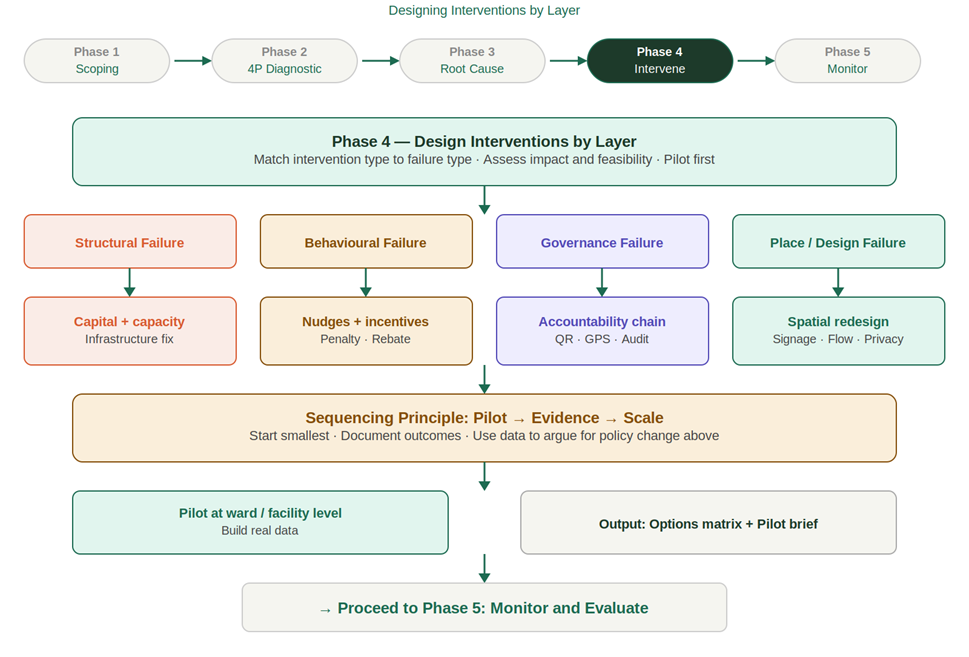
The four intervention types are matched to the four failures
For People failures: change the default, not the motivation
The most durable people-centred sustainability interventions do not rely on goodwill, motivation, or repeated reminders. They change what is easy, visible, and consequential. The evidence from behavioural public policy is consistent across contexts: from waste segregation to water conservation to healthcare compliance to energy use reduction: awareness tells people what to do, but incentive structures and default changes are what actually move behaviour at scale.
The design principle is this: make compliance the path of least resistance. A penalty that is automatic and proportionate. A rebate that rewards the right behaviour without requiring anyone to apply for it. A default setting that produces the desired outcome unless someone actively opts out. Design for the busy, the distracted, and the indifferent, not for the motivated and attentive. The motivated will comply regardless. The system needs to work for everyone else.
For Process failures: close the data-to-action gap
Most sustainability systems already collect data. The failure is rarely due to a lack of information; it is that the information does not automatically trigger a response. Reports are generated and filed. Dashboards are built and opened occasionally. Compliance rates are calculated and presented at quarterly reviews, where no one is empowered to act on them.
The intervention for a process failure is not more data. It is a system redesign that makes non-performance immediately visible to someone with the authority and obligation to respond. Real-time tracking linked to a named reviewer. An automated alert when a threshold is breached. A workflow that converts a data point into an action step without requiring anyone to exercise discretion every time. The technology is secondary. The accountability loop is primary.
For Policy failures, make accountability structural
The most underused intervention in sustainability practice is the accountability chain. A named person at each level of a governance structure, with a defined role, a defined reporting obligation, and a defined consequence for non-performance. It costs almost nothing to design. It requires only political will to enforce, which is precisely why it is so rarely built with teeth.
Policy failures in sustainability almost always share the same anatomy: rules that exist but are not enforced, budgets that are allocated to the visible parts of a system and chronically underspent on the invisible parts, contracts that measure activity rather than outcomes, and oversight bodies that have no consequence for failing to oversee. The intervention must address the anatomy, not the surface. Revise the performance metric. Activate the penalty clause. Convene the review meeting that has not been held in six months. Name the person who is responsible for ensuring it happens next month.
For Place failures, make the right behaviour the obvious behaviour
Physical space shapes behaviour before any rule, campaign, or incentive has a chance to operate. A space that offers no guidance on expected conduct will produce behaviour the system did not intend, not because the people using it are careless, but because they are responding rationally to the environment in front of them.
Place interventions in sustainability are among the most cost-effective available precisely because they change the default without requiring ongoing enforcement. A healthcare facility with a layout that separates patient and visitor flows reduces overcrowding without a single poster or penalty. A public space where waste bins are placed at the natural point of discard increases correct disposal without an awareness campaign. A water standpost positioned at the point of highest footfall increases uptake without a behaviour change programme. The design does the governance work. Get it right and every other dimension becomes easier. Get it wrong, and every other dimension works against itself.
The sequencing principle is non-negotiable
The single most important discipline in intervention design is this: pilot first, build evidence second, scale third.
Every structural change in sustainability governance needs a proof of concept at the smallest viable scale before city-wide, national, or programme-level rollout. Not because the vision is wrong, but because scale without evidence produces a programme with no proof of mechanism, no baseline data, and no credible argument for the sustained budget allocation required to maintain it.
The pilot is not a delay. It is the evidence that makes the policy change possible. Without it, the argument for structural change rests on theory. It rests on proof.
Start at the smallest viable scale. Document obsessively. Then use that evidence to argue for the intervention that will actually hold.
The measure of a good sustainability intervention is not what it achieves during the project. It is what it sustains after the project ends.
Before you recommend anything
1. Produce an intervention options matrix. At least 3 options, each matched to the failure type identified in Phase 3. Assess each on two axes: impact, does it address the root cause or a symptom, and feasibility, cost, time, political will required, and capacity of the governing institution to maintain it after handover.
2. Ask the handover question before you design. The best intervention is not the most technically impressive one. It is the one that addresses the root cause and can be sustained by the people responsible for the system once the engagement ends. If the governing institution cannot maintain it, the intervention design must be simplified until it can, or capacity building must be a primary deliverable rather than an afterthought.
3. Define the pilot scope explicitly. One ward. One facility. One corridor. One community. The pilot scope must be small enough to generate clean data and large enough to be replicable. Name the geography, population, timeline, and three indicators that will determine whether the model is ready to scale.